|
|

 Chennai, India (PTI) Oct 28, 2009 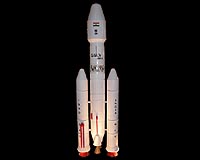 After its maiden moon mission, the Indian Space Research Organisation (ISRO) is hoping to cross another milestone in December - take India into the exclusive club of countries that have developed their own cryogenic engines to power satellites in space. ISRO is hoping to end 2009 in style with the take-off of its fully indigenous geosynchronous satellite launch vehicle (GSLV) carrying an ... read more
  Sydeny, Australia (SPX) Oct 27, 2009
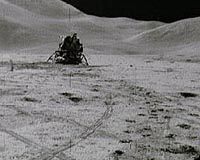
When Apollo astronauts landed on the Moon, they found it wasn't easy to walk around. The low gravity, uneven ground and bulky spacesuits hindered their movement. To move long distances quickly, the astronauts found it was easier to make small "kangaroo hops" with both legs. They would literally propel themselves above the surface before they made gentle falls to the ground. Machines that ... more
|

| |||||||||||||||
| Previous Issues | Oct 27 | Oct 26 | Oct 23 | Oct 22 | Oct 21 |
| . |
  Bethesda MD (SPX) Oct 27, 2009
In response to a Launchspace request for comments, we have a guest commentary by Phil Henderson, Space Systems Engineer, Palm Bay, Florida: Exploration of Mars is a worthy goal, but it should not be the only goal. In fact, it alone could become like Kennedy's original moon goal and once completed, it becomes "been there, done that". A more worthy goal might be: To establish one or more ... more   Moffett Field CA (SPX) Oct 27, 2009
Forty years ago, the Apollo astronauts traipsed across our Moon, making it "inhabited" for the first time - albeit for only two and half hours. A bona-fide habitable moon has never been found, but astronomers are considering how we might find one around distant stars. "I think exomoons are just as interesting as exoplanets," says David Kipping of University College London. In our own ... more   Bangalore, India (SPX) Oct 27, 2009
Exuding confidence that India's space programme will soar fresh heights under new ISRO chief K Radhakrishnan, its outgoing chairman G Madhavan Nair on Monday said. His successor will be able to carry forward the agency's plans, including the most challenging manned moon mission to space. "He (Radhakrishnan) is a talented and highly competent scientist. He knows things as he has been there ... more |
. |
|
|
. |
 Silicon Valley, Calif. (UPI) Oct 18, 2009
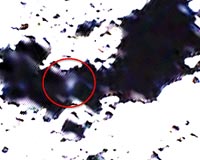
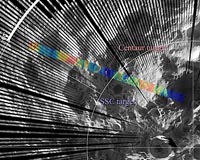
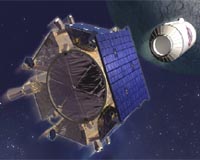
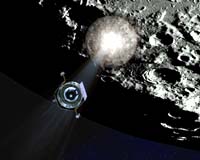
 The spacecraft that plowed into the moon last week kicked up a cloud of dust after all, as NASA had hoped, officials said. Early indications had suggested the Centaur rocket failed to stir up the dust. But the Ames Research Center in Northern California released images Friday showing the rocket indeed had the desired effect, the Los Angeles Times reported. A plume of debris ... more  Huntsville AL (SPX) Oct 16, 2009
How do you fly on a world with no atmosphere? Wings won't work and neither do propellers. And don't even try that parachute! NASA engineer Brian Mulac has the answer. "All it takes is practice, practice, practice," he says. "And of course, thrusters." The space agency is perfecting the art using a prototype lunar lander at the Marshall Space Flight Center: "What we've got here is a 'flying ... more 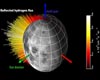 Paris, France (ESA) Oct 16, 2009
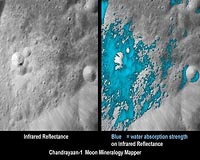
The Moon is a big sponge that absorbs electrically charged particles given out by the Sun. These particles interact with the oxygen present in some dust grains on the lunar surface, producing water. This discovery, made by the ESA-ISRO instrument SARA onboard the Indian Chandrayaan-1 lunar orbiter, confirms how water is likely being created on the lunar surface. It also gives scientists an ... more |
. |
| Previous Issues | Oct 27 | Oct 26 | Oct 23 | Oct 22 | Oct 21 |
| The contents herein, unless otherwise known to be public domain, are Copyright 1995-2009 - SpaceDaily. AFP and UPI Wire Stories are copyright Agence France-Presse and United Press International. ESA Portal Reports are copyright European Space Agency. All NASA sourced material is public domain. Additional copyrights may apply in whole or part to other bona fide parties. Advertising does not imply endorsement, agreement or approval of any opinions, statements or information provided by SpaceDaily on any web page published or hosted by SpaceDaily. Privacy statement |