 |
 |
 |
 |
 |
 |
 |
 |
 |

 |
Nano Paint Could Boost Antiterrorism, Rescue Efforts
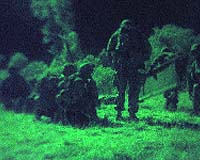
Toronto ON (SPX) Jan 31, 2005 Night vision technology could become extremely precise thanks to an inexpensive water-based material capable of boosting particles of light in the infrared spectrum, say University of Toronto researchers. The material has the potential to enhance infrared images tenfold by coating lenses with a film a 10th of a millimetre thick and powering the material with a laser. In a study published the January issue of the journal Optics Letters, U of T professors Ted Sargent and Eugenia Kumacheva and colleagues produced optical gain - boosting the power in a beam of light the way a stereo boosts electrical signals - using nanometre-sized particles originally suspended in water. The material can be coated onto computer chips, sprayed onto windows and painted onto flexible fabrics to reveal a new infrared world - featuring colours with wavelengths longer than the human eye can see. "The infrared is the wavelength used to send billions of bits of information over thousands of kilometres in fibre-optic cables," says Sargent, a professor at U of T's Edward S. Rogers Sr. Department of Electrical and Computer Engineering. "Not only does it enable night vision in antiterrorism and search and rescue but it may be used to detect cancer in the first cells to become malignant because living tissue is transparent in certain colours in the infrared." Chemistry professor Eugenia Kumacheva, the Canada Research Chair in Advanced Polymer Materials, and her team created quantum dots - nanometre-sized particles of the semiconductor lead sulfide - which produce light at carefully chosen infrared wavelengths. Kumacheva and her team invented a simple, one-stage, water-based synthesis that produced ready-to-use quantum dots. The engineers then made thin, smooth films out of Kumacheva's materials by depositing a drop of water containing the nanoparticles onto a piece of glass and simply letting it dry. "When we used intense lasers to excite the nanomaterial, we found that the film could double the power of light in a propagating beam every 30 microns - about a thousandth of an inch," says Sargent, the Nortel Networks - Canada Research Chair in Emerging Technologies. Amplifying light is necessary for making a laser, for boosting signals on an optical communications chip and for enhancing infrared images in biological and antiterrorism applications. The findings complement a breakthrough also made by Sargent and colleagues that was reported in Nature Materials Jan. 9. The team reported a paintable material that for the first time could sense light and harness the sun's energy at tailored wavelengths in the infrared. "The field of spray-on infrared nanotechnology is leaping ahead week-by-week," said Sargent. "The Jan. 9 discovery senses and harvests infrared light; today's boosts it. Applying these paintable infrared materials is splashing open a new palette: colouring our world using the shades we cannot see, but which power the Internet, reveal warm objects against a cold background and allow non-invasive diagnosis before disease has the chance to progress."
Email This Article
Related Links |
|
|

| The content herein, unless otherwise known to be public domain, are Copyright 1995-2006 - SpaceDaily.AFP and UPI Wire Stories are copyright Agence France-Presse and United Press International. ESA PortalReports are copyright European Space Agency. All NASA sourced material is public domain. Additionalcopyrights may apply in whole or part to other bona fide parties. Advertising does not imply endorsement,agreement or approval of any opinions, statements or information provided by SpaceDaily on any Web page published or hosted by SpaceDaily. Privacy Statement |