 |
 |
 |
 |
 |
 |
 |
 |
 |

 |
Researchers Develop New Tool To Detect Agents Of Bioterrorism
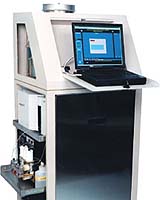
Livermore CA (SPX) Jan 11, 2005 Scientists have developed a new "biological smoke detector" to help protect against potential bioterrorist attacks, according to a study published in the Jan. 1 edition of Analytical Chemistry, a peer-reviewed journal of the American Chemical Society, the world's largest scientific society. High-traffic facilities like airports, office buildings, rail stations and sporting arenas serve hundreds of thousands of people each day, making them particularly susceptible to silent and invisible biological attacks. Researchers from Lawrence Livermore National Laboratory in California have now developed a new stand-alone detector that can provide early warning to help authorities limit exposure and start treating victims before they show symptoms of full-blown infection. The instrument, called the Autonomous Pathogen Detection System, or APDS, continuously monitors the air like a "biological smoke detector," says John Dzenitis, Ph.D., a chemical engineer at LLNL and corresponding author of the paper. It is capable of detecting and identifying three types of biological agents: bacteria, viruses and toxins, including such familiar threats as anthrax, plague and botulinum toxin. The machine runs the same tests that molecular biologists would carry out in a laboratory to detect biological agents, providing information that is required before definitive public-health action can be taken. LLNL has been working on this instrument since 1995, but this new version, tested at the U.S. Army's Dugway Proving Grounds in Utah, is a step-change in capability, Dzenitis says. Now, in addition to simultaneously testing for multiple agents with protein antibodies, the APDS also confirms positive results with a DNA test specific for the agent. No other field system has two independent molecular biology tests. Having two laboratory-quality tests further reduces the probability of a false alarm and gives confidence for effective response. Email This Article
Related Links  Washington DC (UPI) Jan 06, 2005
Over the remaining nine months of the U.S. government's 2005 fiscal year billions of dollars will spent on biodefense and more billions likely will be agreed too. What will emerge, however, is an ever louder debate over whether the money is being well spent. |
|
|

| The content herein, unless otherwise known to be public domain, are Copyright 1995-2006 - SpaceDaily.AFP and UPI Wire Stories are copyright Agence France-Presse and United Press International. ESA PortalReports are copyright European Space Agency. All NASA sourced material is public domain. Additionalcopyrights may apply in whole or part to other bona fide parties. Advertising does not imply endorsement,agreement or approval of any opinions, statements or information provided by SpaceDaily on any Web page published or hosted by SpaceDaily. Privacy Statement |